Shopping cart
Your cart empty!
Your cart empty!

Join 10k+ people to get notified about new posts, news and tips.
Do not worry we don't spam!
September 14, 2026 | Financial Markets
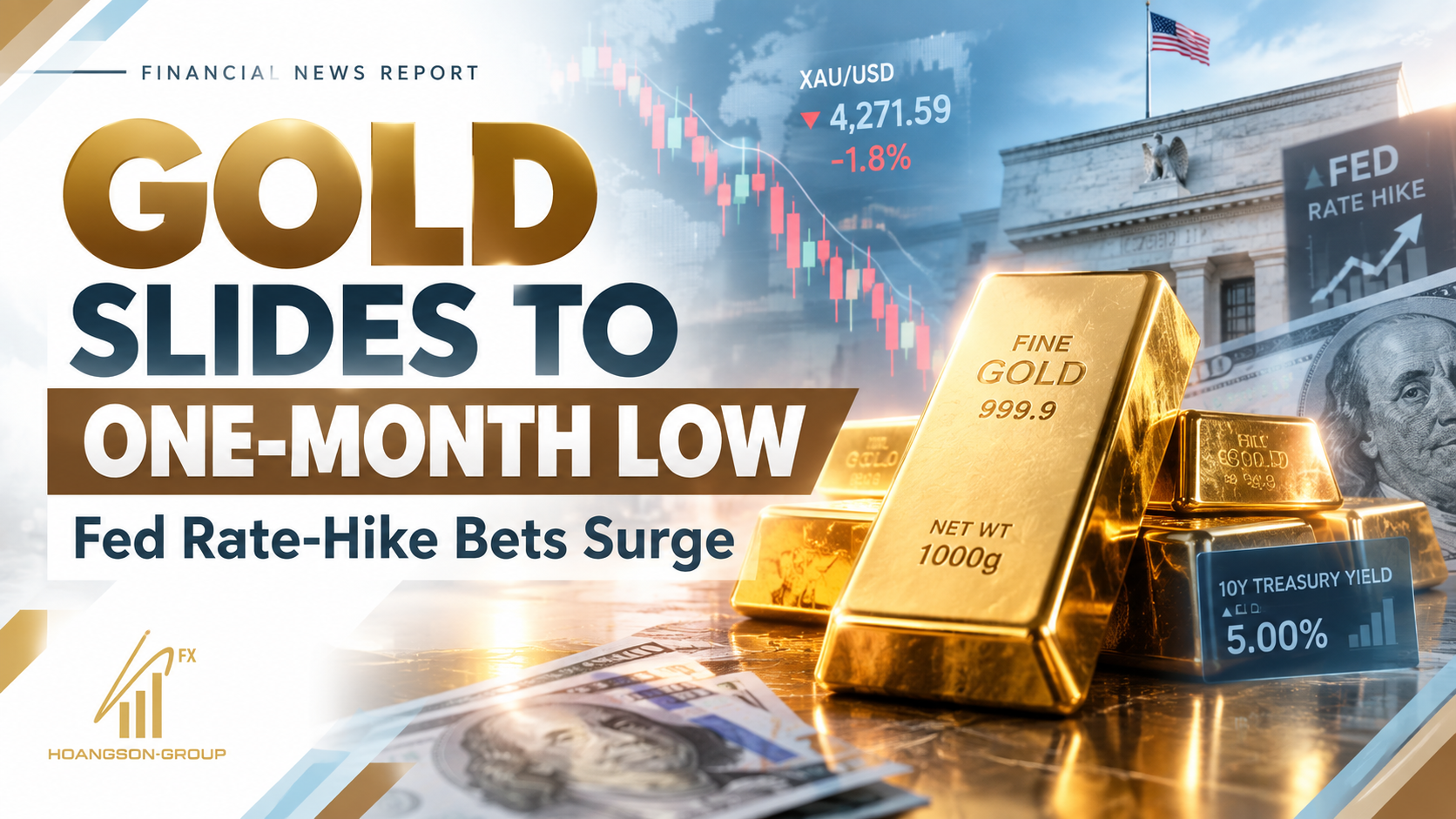
Gold prices fell to their lowest level in more than a month on Monday as stronger-than-expected U.S. inflation data, rising oil prices and a stronger dollar pushed investors to increase bets on another Federal Reserve interest-rate hike.
Spot gold fell about 1.8% to $4,271.59 an ounce, while U.S. gold futures declined around 2.2% to $4,311.20. The move came as investors repositioned ahead of the Federal Reserve's policy meeting on September 15–16.
The latest U.S. consumer-price data showed inflation rising 0.4% in August, adding to concerns that price pressures remain too strong for the Federal Reserve to comfortably ease monetary policy.
Markets are now pricing roughly an 89% probability of a Fed rate increase at this week's meeting. Several major banks have also moved toward expectations for a 25-basis-point increase.
For gold, the shift is significant.
Higher interest rates generally increase the opportunity cost of holding bullion because gold does not generate interest income. At the same time, higher U.S. yields can support the dollar, creating additional pressure on dollar-denominated gold.
The inflation story has been complicated further by a renewed surge in oil prices.
Brent crude moved above $108 a barrel as geopolitical tensions in the Middle East threatened energy supplies and shipping routes. The increase in energy prices has raised concerns that inflation could remain elevated for longer, giving central banks another reason to maintain or increase restrictive monetary policy.
This has created an unusual environment for gold: geopolitical uncertainty is normally supportive for safe-haven demand, but the resulting increase in energy prices is simultaneously strengthening expectations for higher interest rates.
The U.S. Treasury market is also putting pressure on gold.
The 10-year U.S. Treasury yield reached 5% on Monday, its highest level since 2023, reflecting a broader global bond sell-off driven by inflation concerns, higher oil prices and expectations for tighter monetary policy.
Rising Treasury yields make interest-bearing assets more attractive relative to gold and have contributed to the recent decline in bullion prices.
Despite the sharp short-term correction, underlying investment demand for gold remains substantial.
According to the World Gold Council, physically backed gold ETFs attracted approximately $18 billion in August, their second-largest monthly inflow on record. Global ETF holdings increased by 121 tonnes to a record 4,189 tonnes, while total assets under management rose 16% month-on-month to approximately $615 billion.
The data suggests that institutional demand for gold remains strong even as traders respond to changing interest-rate expectations.
August also saw a significant increase in gold-market activity, with average daily trading volumes rising 21% month-on-month to approximately $430 billion.
Gold is now facing a critical test.
In the short term, the bias has turned increasingly bearish as the dollar strengthens, Treasury yields rise and expectations for Fed tightening increase.
However, the broader gold investment story remains supported by strong ETF demand, geopolitical uncertainty and continued investor interest in gold as a portfolio diversifier.
The key event this week will be the Federal Reserve's September meeting. The rate decision itself is important, but markets are likely to focus even more closely on the Fed's guidance regarding future rate increases.