Shopping cart
Your cart empty!
Your cart empty!

Join 10k+ people to get notified about new posts, news and tips.
Do not worry we don't spam!
August 17, 2026 | Global Financial Markets
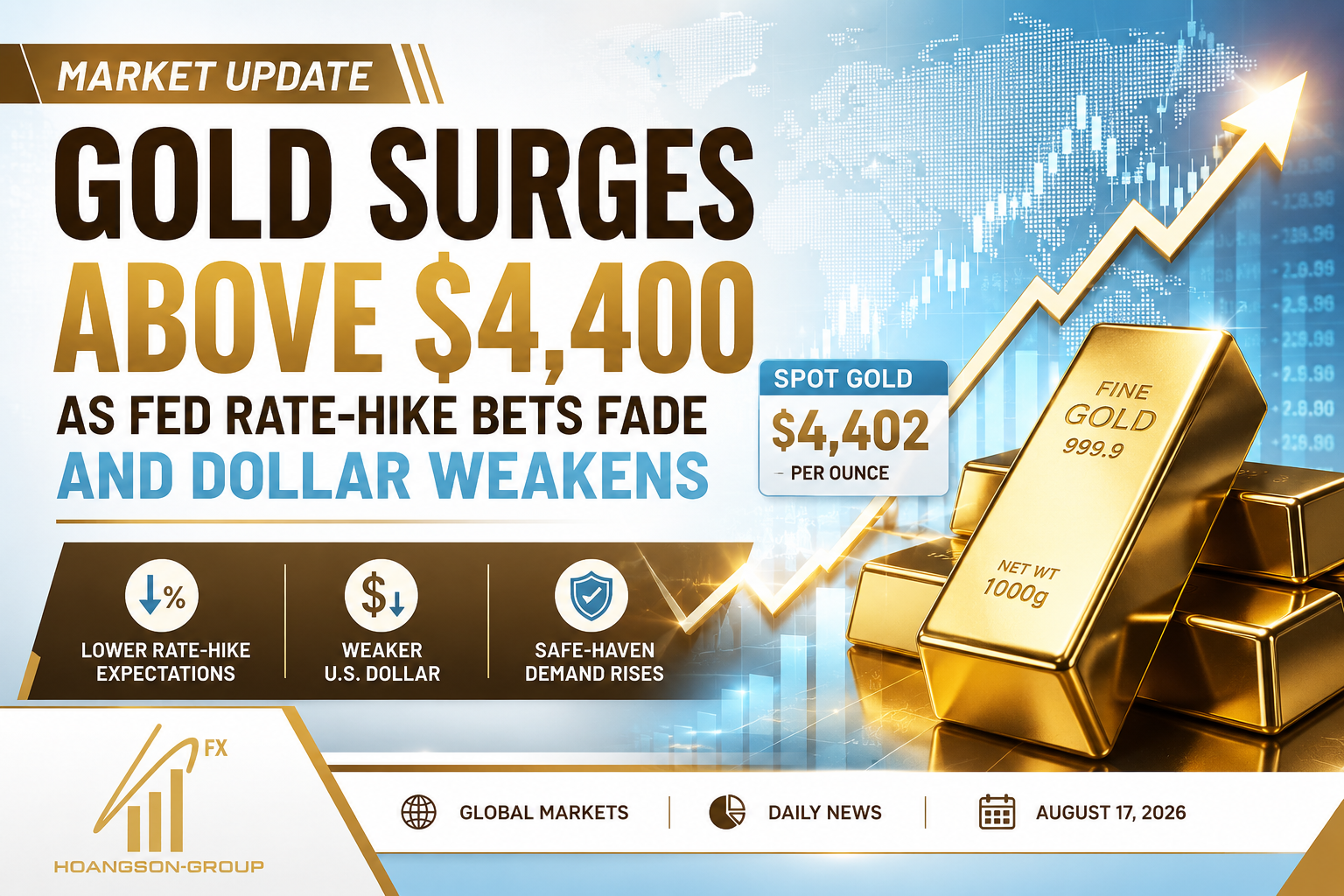
Gold prices advanced on Monday as a weaker U.S. dollar and fading expectations of another Federal Reserve interest-rate hike boosted demand for the precious metal.
Spot gold climbed around 0.6% to $4,402.49 per ounce, reaching its highest level in more than two months. U.S. gold futures also gained approximately 0.5% to $4,458.70.
The latest move extends gold's strong August recovery. Market data showed gold trading around $4,394 per ounce on August 17, up roughly 9.6% over the past month and more than 31% higher than a year earlier.
The primary catalyst behind the latest gold rally is a shift in expectations for U.S. monetary policy.
Recent U.S. jobs and inflation data have been softer than previously expected, encouraging traders to reduce bets on another Federal Reserve rate hike. Markets are currently pricing roughly a 31% probability of a September rate hike, compared with about 51% a month earlier.
This matters for gold because bullion does not generate interest income. When investors expect interest rates and bond yields to fall, the opportunity cost of holding gold declines, making the metal more attractive relative to interest-bearing assets.
The U.S. dollar also moved lower on Monday, with the dollar index falling approximately 0.3%.
A weaker dollar generally supports gold because the metal is priced in U.S. dollars. When the dollar declines, gold becomes relatively cheaper for investors holding other currencies, potentially increasing international demand.
U.S. Treasury yields have also eased, although they remain relatively elevated. The 10-year Treasury yield was around 4.68%, while the two-year yield stood near 4.16%.
Attention now turns toward the Federal Reserve's July meeting minutes, scheduled for release on Wednesday.
Investors will be looking for clues about how policymakers view inflation, economic growth and the possibility of future rate increases.
A more dovish interpretation could further weaken the dollar and Treasury yields, potentially creating another bullish catalyst for gold. Conversely, signs that policymakers remain concerned about inflation could push yields and the dollar higher and trigger profit-taking in gold.
Gold's longer-term story is not dependent solely on the Federal Reserve.
The World Gold Council's latest Q2 2026 data showed global gold demand, including over-the-counter activity, at 1,269 tonnes, broadly unchanged year over year. Total first-half demand reached 2,522 tonnes, approximately 2% higher year over year.
Central-bank demand continues to be an important component of the market. The World Gold Council has highlighted continued official-sector activity, while its latest research also shows that gold demand remains supported by investment and strategic reserve diversification.
This creates an important distinction for the current market: short-term gold prices are being driven heavily by interest-rate and dollar expectations, while longer-term demand continues to receive support from central banks and investors.
Geopolitical uncertainty remains another factor supporting demand for safe-haven assets.
Developments surrounding the Middle East continue to influence financial markets, particularly through oil prices, inflation expectations and broader risk sentiment. Any significant escalation could increase demand for gold as investors seek protection from geopolitical uncertainty.
However, the relationship is not straightforward. A major increase in oil prices could also revive inflation concerns, potentially pushing bond yields and the dollar higher—factors that could temporarily work against gold.
At the same time, the rally is becoming increasingly extended, meaning profit-taking and short-term corrections remain possible.
For traders watching XAU/USD, the $4,400 region has become an important psychological area.
A sustained move above this zone could strengthen bullish momentum and open the door toward higher resistance levels. Failure to hold above the area, however, could trigger a short-term pullback as traders lock in profits following August's strong rally.
The biggest risks to the bullish outlook would be:
1. Stronger U.S. economic data A renewed improvement in employment, inflation or growth could increase expectations for higher rates.
2. Higher Treasury yields Rising yields increase the opportunity cost of holding non-yielding gold.
3. A stronger U.S. dollar Dollar appreciation can pressure dollar-denominated gold prices.
4. Hawkish Fed communication A stronger-than-expected message from the Federal Reserve could rapidly change rate expectations.
5. Profit-taking After a sharp August rally, short-term traders may begin taking profits even if the longer-term trend remains positive.
The immediate gold environment remains bullish, with price momentum supported by falling rate-hike expectations, dollar weakness and renewed investor demand.
However, the next phase of the rally is likely to depend heavily on whether the Federal Reserve confirms the market's increasingly dovish expectations.
The Fed minutes on Wednesday therefore represent one of the most important events for gold traders this week.
If the minutes reinforce expectations that the Fed is approaching a less aggressive policy stance, gold could receive another boost. If policymakers signal persistent inflation concerns and a willingness to maintain tighter policy, gold could face renewed pressure.