Shopping cart
Your cart empty!
Your cart empty!

Join 10k+ people to get notified about new posts, news and tips.
Do not worry we don't spam!
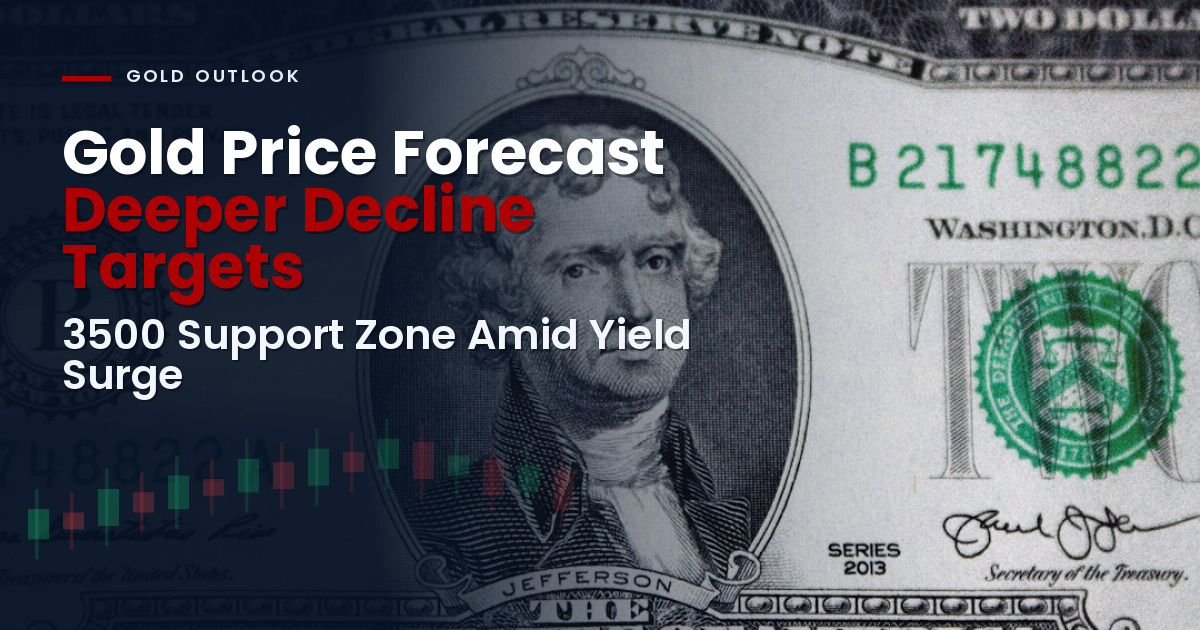
New York, HSGFX - Spot gold prices are extending a sharp downward correction toward the critical $3,500 support zone, pressured by a combination of elevated US Treasury yields and sustained foreign exchange demand for the US dollar. Precious metals traders are actively assessing critical technical breakdown levels as traditional safe-haven flows stall across global trading desks. The precious metal, monitored closely via XAU/USD price action, faces intensified selling pressure as macroeconomic crosscurrents alter the near-term trajectory for non-yielding bullion.
The broader foreign exchange market reflects persistent strength in the US Dollar Index (DXY), which continues to command capital flows away from alternative assets. Global currency participants are reassessing the valuation dynamics of major pairs such as EUR/USD and GBP/USD in tandem with the ongoing commodity retreat. This currency strength forms a formidable headlock on bullion, restricting upward momentum during the initial Asian and early European session hours.
Driving the persistent downward bias in gold are elevated US Treasury yields across the curve. Benchmark 10-year and 2-year yields remain well-supported, reflecting ongoing adjustments in global bond markets to resilient macroeconomic data prints out of Washington, D.C. Higher sovereign yields increase the opportunity cost of holding physical bullion, prompting institutional investors to reallocate capital toward fixed-income instruments offering attractive risk-adjusted returns.
The central bank policy landscape remains a primary focal point for institutional market participants worldwide. Expectations regarding the Federal Reserve monetary policy path have evolved significantly, with traders scaling back aggressive easing bets. This reassessment directly influences real interest rates, serving as a primary catalyst for the recent pullback in precious metals. Central bank communication from global policy forums continues to emphasize data-dependent approaches, leaving bond and currency markets vulnerable to sudden repricing.
Beyond the Federal Reserve, other major global central banks including the European Central Bank, the Bank of England, and the Bank of Japan are navigating distinct domestic inflationary and growth realities. Divergent monetary policy expectations across Frankfurt, London, and Tokyo create complex cross-border capital flows. These policy divergences directly impact the broader currency complex, reinforcing the greenback's relative attractiveness against international peers.
Market sentiment during the transition from the Asian trading session into the London liquidity window highlights acute sensitivity around technical support boundaries. The $3,500 psychological and technical threshold for spot gold acts as the primary line in the sand for market participants. A sustained break below this critical zone risks triggering stop-loss orders and accelerated algorithmic selling across major electronic exchange platforms.
Conversely, a defense of this technical barrier could invite short-covering rallies, though resistance levels higher up remain formidable. Institutional desk commentary notes that safe-haven demand, which typically provides a reliable floor for gold during periods of geopolitical uncertainty, has temporarily taken a back seat to interest rate dynamics and currency appreciation.
Looking ahead, global forex and commodity desks are positioning themselves for an incoming barrage of high-impact macroeconomic data releases. Traders are closely monitoring upcoming United States Consumer Price Index (CPI) inflation prints, employment reports including Non-Farm Payrolls (NFP), and Personal Consumption Expenditures (PCE) data releases. These forthcoming economic indicators will heavily dictate the next directional wave for the US dollar, sovereign bond yields, and spot gold valuations.
Furthermore, forthcoming purchasing managers' index (PMI) surveys across major economies will provide fresh insight into global manufacturing and services momentum. As international markets process these developments, liquidity conditions across New York and London hubs will likely dictate the speed and precision of any tests near major technical support and resistance levels.