Shopping cart
Your cart empty!
Your cart empty!

Join 10k+ people to get notified about new posts, news and tips.
Do not worry we don't spam!
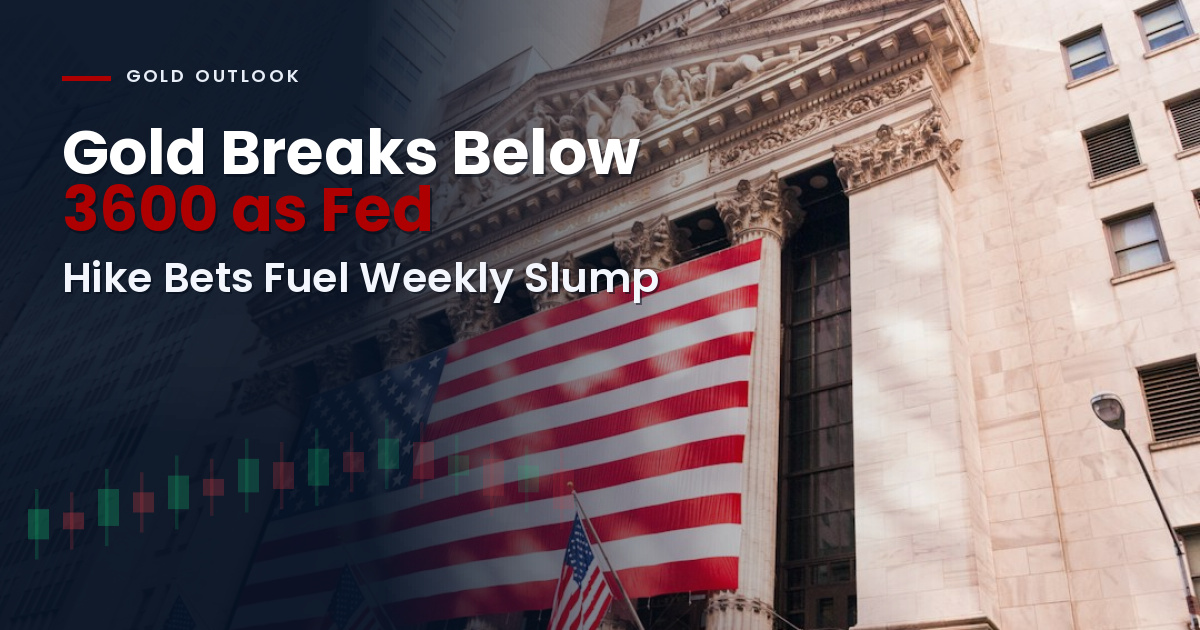
New York, HSGFX - Spot gold prices extended a brutal sell-off on Friday, breaching the key psychological threshold of $3,600 per ounce as aggressive Federal Reserve rate hike bets swept through global financial markets. The precious metal faced intense liquidation pressure, culminating in what is tracking as the worst weekly percentage drop since March. Precious metals traders found themselves navigating extreme volatility and critical support tests as surging US Treasury yields aggressively amplified greenback strength across major currency pairs.
The sharp downward trajectory in XAU/USD underscores a decisive shift in macroeconomic sentiment as global investors reprice terminal interest rate expectations. Throughout the Asian, London, and early New York trading sessions, continuous selling kept the commodity pinned near session lows. The combination of elevated bond yields and persistent US dollar dominance created a profoundly hostile environment for non-yielding assets, leaving bullion bulls with little technical shelter as major institutional stop-losses were triggered below the $3,600 handle.
Underpinning the broader commodity rout is an unrelenting surge in US Treasury yields across the curve. Benchmark 10-year and 2-year sovereign yields advanced sharply following a string of resilient economic data points that challenged earlier dovish consensus views. Higher yields increase the opportunity cost of holding precious metals, accelerating capital flight out of bullion-backed exchange-traded funds and into fixed-income alternatives.
The US Dollar Index (DXY) capitalized aggressively on the widening rate differential, touching multi-week highs against a basket of G10 currencies including the euro, British pound, and Japanese yen. As foreign exchange markets adjust to the reality of higher-for-longer US borrowing costs, currency traders have heavily favored greenback-denominated assets. This broad-based dollar appreciation compounded the downward pressure on XAU/USD, making dollar-priced bullion increasingly expensive for international buyers holding alternative currencies.
At the heart of the current market re-pricing is a fundamental reassessment of Federal Open Market Committee policy trajectories. Federal Reserve officials have maintained a hawkish stance, emphasizing that persistent inflationary pressures necessitate maintaining restrictive monetary settings. Market participants who had previously priced in aggressive policy easing cycles are now capitulating, aligning their portfolios with the prospect of prolonged restrictive rates.
This hawkish pivot stands in stark contrast to the policy postures of other major global central banks, such as the European Central Bank and the Bank of England, both of which face more subdued domestic growth environments. While the Federal Reserve contends with stubborn economic resilience, international counterparts are weighing risks of economic stagnation. This policy divergence has widened interest rate spreads in favor of the US dollar, cementing its status as the dominant macro driver across global forex and commodity desks.
As global trading desks prepare for the weekly close, attention is already shifting toward the upcoming macroeconomic calendar. Upcoming releases of crucial US Consumer Price Index inflation figures, Non-Farm Payrolls employment reports, and Personal Consumption Expenditures data will serve as the next major catalysts for currency and commodity valuations.
Traders across New York, London, and Tokyo will closely scrutinize these upcoming data prints for any signs of labor market cooling or moderating price pressures that might alter the Federal Reserve's policy path. Until concrete evidence emerges to challenge the current narrative of aggressive policy tightening, gold markets are expected to remain highly sensitive to incoming US macroeconomic data, keeping volatility elevated across global currency and commodity markets.