Shopping cart
Your cart empty!
Your cart empty!

Join 10k+ people to get notified about new posts, news and tips.
Do not worry we don't spam!
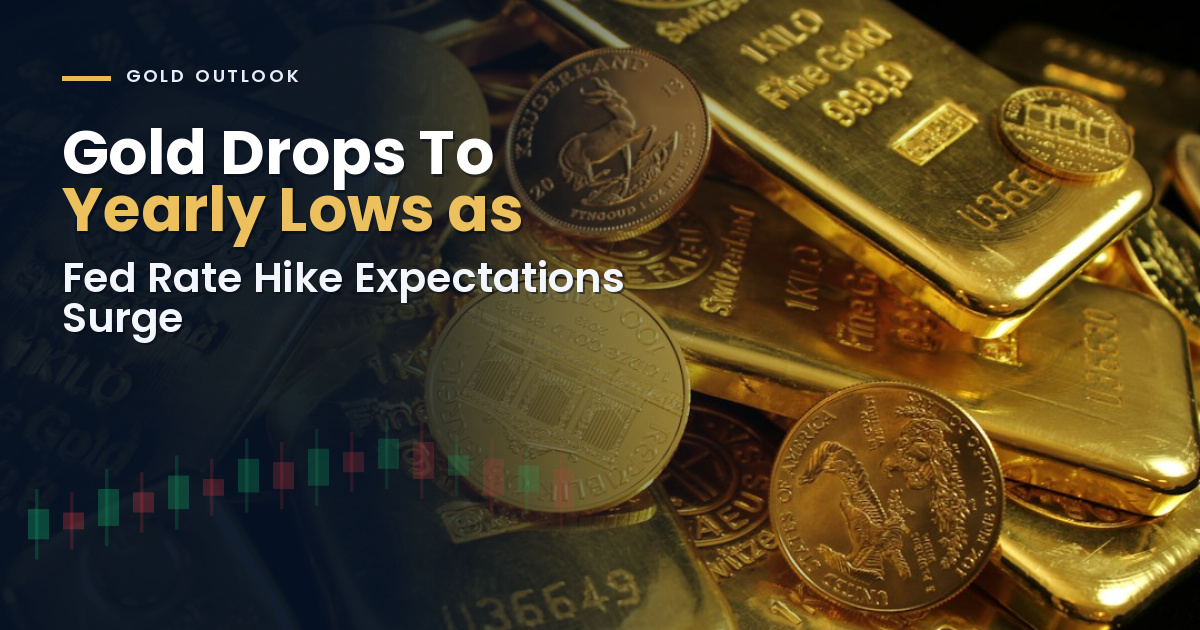
Washington, D.c., HSGFX — Gold prices tumbled sharply during Tuesday's global trading sessions, hitting their lowest level in over a year as aggressive Federal Reserve rate-hike expectations gripped international financial markets. The sudden wave of selling in precious metals was immediately triggered by a surging U.S. dollar, which drew heavy capital inflows away from safe-haven bullion and into high-yielding American debt instruments.
Foreign exchange desks across New York, London, and Tokyo reported intense selling pressure in XAU/USD. Market participants scrambled to reprice currency pairs and commodity valuations as shifting macroeconomic fundamentals redefined the global yield landscape. The relentless advance of the greenback underscores a broad reassessment of U.S. monetary policy trajectories.
Underpinning the dollar's dominance is an aggressive repricing of the Federal Reserve's rate path. Bond markets in Washington and New York have rapidly adjusted to the reality of higher-for-longer interest rates. Persistent inflation pressures and resilient macroeconomic data releases from the United States have forced traders to abandon bets on impending monetary easing, fueling a massive rally in U.S. Treasury yields.
As U.S. sovereign bond yields climbed across the curve, the opportunity cost of holding non-yielding assets like gold bullion expanded dramatically. Institutional portfolios adjusted asset allocations away from precious metals, redirecting liquidity toward dollar-denominated fixed income assets. This capital flight served as the primary catalyst accelerating the downward spiral in XAU/USD.
The divergence in central bank policy stances has further amplified forex market volatility. While the Federal Reserve maintains an aggressively hawkish posture to combat domestic price pressures, other major global central banks including the European Central Bank, the Bank of England, and the Bank of Japan face distinct economic headwinds that complicate their respective policy outlooks.
In Frankfurt, policymakers monitor slowing regional growth alongside moderating inflation metrics, creating a stark policy gap relative to Washington. Meanwhile, the Bank of Japan continues to navigate delicate normalization steps against a backdrop of volatile currency valuations. This transatlantic policy divergence has cemented the U.S. dollar index (DXY) near formidable multi-month resistance levels.
During the Asian and early European trading windows, bullion attempted to find a technical foothold near critical long-term support zones. However, persistent macro selling pressure from New York desks overwhelmed defensive bids. Momentum-driven algorithmic models compounded the downside momentum, breaking through psychological price thresholds that had held firm for the better part of the past twelve months.
Global forex and commodities traders are now shifting their attention toward an intensive calendar of upcoming macroeconomic data releases. Key reports on the radar include upcoming U.S. Consumer Price Index inflation prints, monthly Non-Farm Payrolls, Personal Consumption Expenditures data, and crucial Purchasing Managers Index surveys from major industrial economies.
These upcoming data points will serve as the next crucial test for institutional sentiment. Any unexpected softness in U.S. employment or inflation metrics could trigger a sharp corrective pullback in the U.S. dollar, offering temporary relief to battered gold bulls. Conversely, stronger-than-expected data will likely reinforce the Federal Reserve's restrictive stance, keeping XAU/USD under intense structural pressure as markets reevaluate the global monetary policy horizon.