Shopping cart
Your cart empty!
Your cart empty!

Join 10k+ people to get notified about new posts, news and tips.
Do not worry we don't spam!
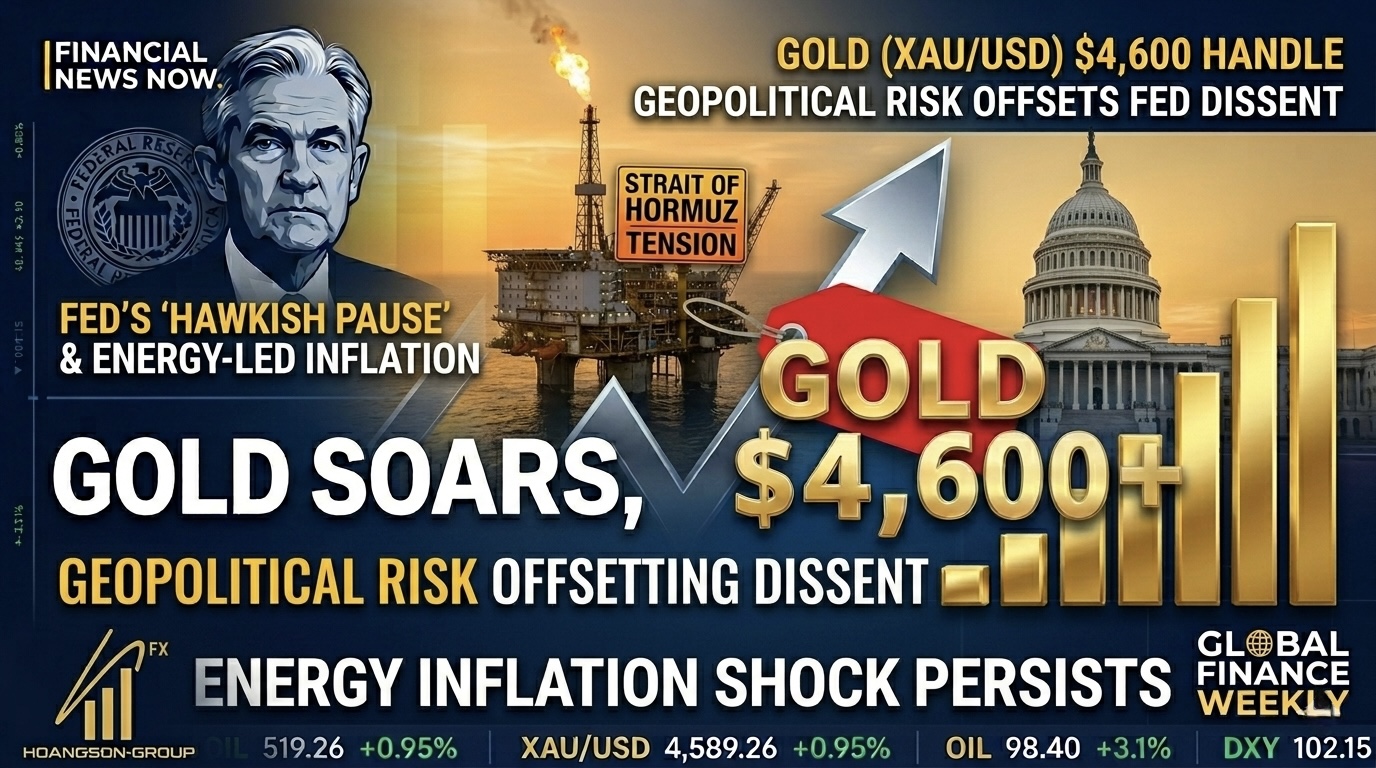
Safe-Haven Bid: Gold (XAU/USD) climbed back toward $4,600/oz as the U.S. naval blockade on Iran and disruptions in the Strait of Hormuz elevated global risk premiums.
Hawkish Pause: The Federal Open Market Committee (FOMC) kept the federal funds rate at 3.50%–3.75%, though four officials dissented in favor of a hike, citing "sticky" energy-driven inflation.
Inflation Shock: March CPI data showed a sharp 10.87% monthly surge in energy prices, pushing headline inflation to 3.3% YoY.
Leadership Transition: Markets are bracing for Jerome Powell’s departure on May 15, with nominee Kevin Warsh expected to inherit a volatile "energy-shock" economy
The global macro landscape is currently dominated by a "double-shock" of geopolitical instability and persistent price pressures. The ongoing conflict in the Middle East has transitioned from a localized concern to a systemic threat to global trade. With the Strait of Hormuz partially closed, oil and gas prices have surged, creating a mechanical pass-through effect into the U.S. Consumer Price Index (CPI). The Federal Reserve's decision to hold rates steady this week was widely expected, but the internal rift within the committee—marked by four hawkish dissents—signals that the era of "easy" disinflation is over. Fed Chair Jerome Powell, in his final press conference, acknowledged the "energy shock of some size and duration," forcing traders to price out 2026 rate cut expectations and move toward a "higher for longer" stance into 2027.
Gold (XAU/USD): After touching a one-month low of $4,550 on Wednesday, spot gold rose 0.95% to $4,589.26 during Thursday’s session.
Fixed Income: The 2-year Treasury yield climbed 6 basis points to 4.12%, reflecting fears that the Fed may be forced to hike later this year if energy costs remain unanchored.
Equities: The S&P 500 fell 0.6%, while the Russell 2000 dropped 1.1%, as small-cap firms struggle with the dual burden of high borrowing costs and rising input prices.
US Dollar (DXY): The Greenback remained flat-to-positive, supported by safe-haven flows despite the overall rebound in commodities.
From a technical perspective, Gold remains in a primary bullish trend despite the recent correction. The $4,550 level has emerged as a critical structural support, coinciding with the 50-day Moving Average.
Resistance: Immediate resistance sits at $4,620. A daily close above this level could open the door for a retest of the $4,750 psychological barrier.
Support: If $4,550 fails to hold, the next downside target is the $4,480 zone (Fibonacci 61.8% retracement of the Q1 rally).
Bias: The Relative Strength Index (RSI) is hovering near 52, suggesting a neutral-to-bullish momentum shift as the market digests the Fed's hawkish tone against the backdrop of war.