Shopping cart
Your cart empty!
Your cart empty!

Join 10k+ people to get notified about new posts, news and tips.
Do not worry we don't spam!
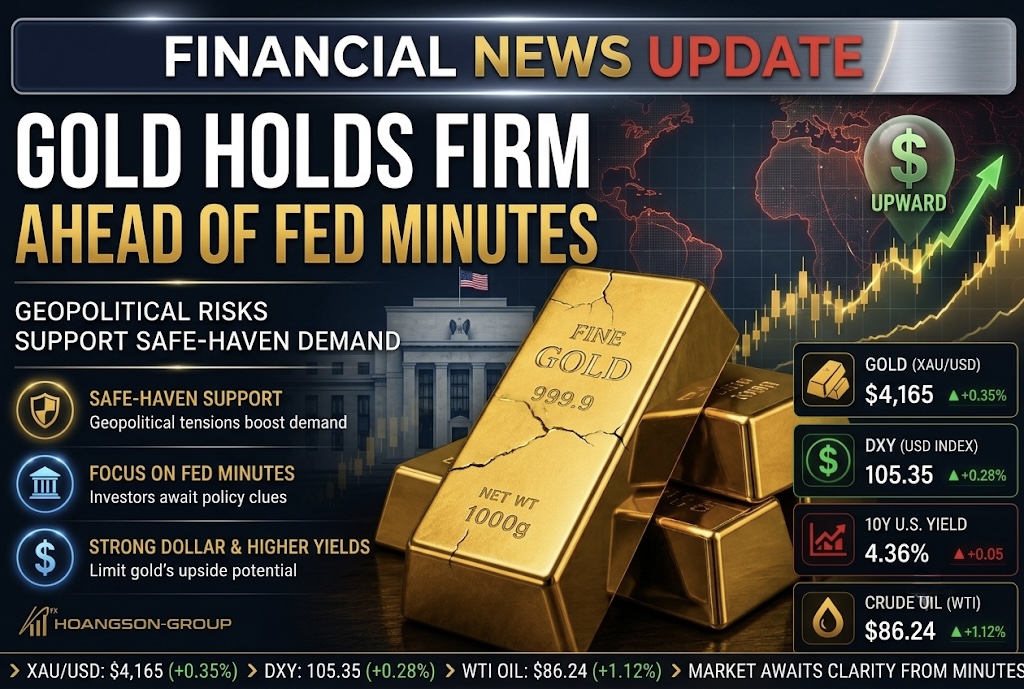
Gold prices stabilized on Wednesday as investors balanced renewed geopolitical tensions in the Middle East against a stronger U.S. dollar and rising Treasury yields, while awaiting the Federal Reserve's June meeting minutes for fresh policy guidance.
Gold (XAU/USD) traded with a cautiously positive tone during the latest session as financial markets weighed two opposing macroeconomic forces: higher interest-rate expectations in the United States and renewed geopolitical uncertainty.
The primary catalyst remains the upcoming release of the Federal Reserve's June FOMC meeting minutes. Investors are looking for greater clarity on how policymakers assess inflation risks, labor-market conditions, and whether additional monetary tightening could still be warranted later this year.
Recent market pricing suggests investors are assigning meaningful odds to another Fed rate increase in the coming months following resilient inflation and elevated energy prices. Higher policy expectations have supported the U.S. dollar while pushing benchmark Treasury yields toward recent highs.
Meanwhile, geopolitical developments involving the United States and Iran have increased uncertainty across global financial markets. Rising crude oil prices have reinforced concerns that higher energy costs could slow the disinflation process, complicating the Fed's path toward achieving its inflation target.
Although elevated interest rates generally weigh on non-yielding assets such as gold, persistent geopolitical risks continue to provide an important source of underlying support for precious metals. Analysts note that central-bank gold purchases and reserve diversification remain constructive longer-term themes despite recent price volatility.
Financial markets displayed mixed performance as investors positioned ahead of key macroeconomic events.
From a technical perspective, gold remains in a short-term recovery phase following a sharp correction from earlier record highs.
Key Support
Key Resistance
Momentum indicators suggest selling pressure has eased, although buyers will likely require a sustained move above the $4,200–4,250 region to confirm a stronger bullish recovery. A break below $4,000 could expose the market to another wave of liquidation.
The near-term direction for gold will likely depend on several major macroeconomic catalysts:
Should inflation show renewed signs of persistence, markets may continue pricing in tighter monetary policy, potentially strengthening the dollar and limiting gold's upside. Conversely, softer inflation data or more dovish language from Federal Reserve officials could ease yield pressure and provide fresh support for bullion.
For now, gold remains caught between competing forces: elevated real yields and a stronger U.S. dollar on one side, and persistent geopolitical uncertainty alongside ongoing safe-haven demand on the other. Until clearer policy signals emerge, traders are likely to remain focused on incoming economic data and central-bank communication for the next directional move.