Shopping cart
Your cart empty!
Your cart empty!

Join 10k+ people to get notified about new posts, news and tips.
Do not worry we don't spam!
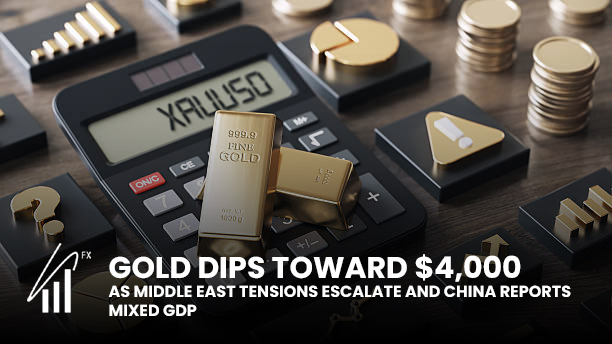
Gold prices slipped on Wednesday as investors carefully balanced rising geopolitical risks in the Middle East against a softer US dollar and mixed economic signals from China.
Spot gold fell 0.6% to $4,028.40 an ounce, while US gold futures dropped 0.9% to settle at $4,034.75. Meanwhile, oil prices extended their gains for a third consecutive session, with Brent crude futures climbing toward $86 a barrel.
| Asset / Indicator | Price / Rate | Change / Context |
| Spot Gold | $4,028.40 / oz | Down 0.6% |
| US Gold Futures | $4,034.75 / oz | Down 0.9% |
| Brent Crude Oil | ~$86.00 / bbl | Climbing on supply disruption risks |
| China Q2 GDP | 4.3% | Weakest pace since late 2022 (missed expectations) |
The primary driver behind rising energy prices is a sharp escalation in the Middle East, centered around the vital Strait of Hormuz shipping lane.
US naval forces have resumed blockades on vessels moving to and from Iranian ports. In response, US President Donald Trump threatened direct strikes on Iranian infrastructure if Tehran refuses to return to the negotiating table.
"I’ll save the energy targets for last, but ultimately their energy targets will be hit. We’re going to knock out all their power plants. We’re gonna knock out their bridges unless they get to the table and negotiate," Trump stated in an interview with Fox News.
US Deployment: The US Central Command confirmed that more than 20 US Navy warships and hundreds of military aircraft are currently active and on high alert across the region.
Iranian Counter-Strikes: Iran’s Islamic Revolutionary Guard Corps (IRGC) retaliated with a pre-dawn missile strike on the US Al-Azraq Air Base in Jordan, warning that oil routes for US allies would be actively targeted.
Regional Alerts: Early morning missile sirens were activated in both Bahrain and Kuwait as they faced incoming fire from Iranian territory.
Despite the geopolitical chaos—which usually pushes investors toward safe-haven assets like gold—the precious metal faced downward pressure. This is partly due to a struggling US Dollar.
The greenback fell from its recent two-week high following softer-than-expected US inflation data. The cooler inflation numbers have prompted traders to scale back their expectations of aggressive rate hikes by the Federal Reserve. Typically, prospects of lower interest rates support gold, but the broader market liquidity seems diverted into volatile energy markets.
Adding to the global economic uncertainty, China reported a 4.3% GDP growth rate for the second quarter. This marks the country's slowest expansion rate since late 2022, missing consensus market forecasts.
However, it wasn't entirely bad news. Accompanying retail sales and industrial output data for June showed modest signs of recovery, suggesting that Chinese consumer activity may finally be turning a corner.
Adding to the complex macro-backdrop, the Trump administration faced a domestic setback as US Senate Democrats successfully blocked the $1.15 trillion National Defense Authorization Act (NDAA). The crucial funding bill was defeated in a strict party-line vote, complicating Washington's legislative path forward just as military commitments in the Middle East intensify.