Shopping cart
Your cart empty!
Your cart empty!

Join 10k+ people to get notified about new posts, news and tips.
Do not worry we don't spam!
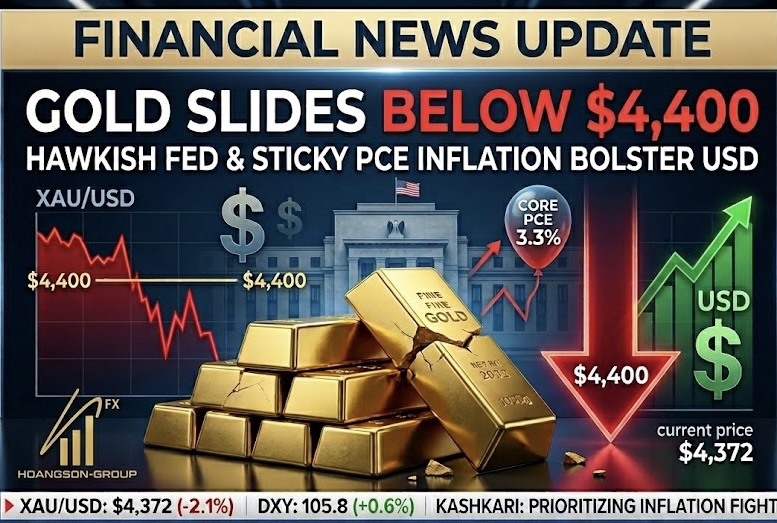
Gold (XAU/USD) is trading near $4,372–$4,400, testing critical support after breaking below the psychological $4,400 mark.
Sticky Inflation Data: The U.S. Core PCE price index data points to resilient inflation (3.3%), dampening hopes for imminent Federal Reserve rate cuts.
Hawkish Fed Speak: Minneapolis Fed President Neel Kashkari’s recent comments prioritize the inflation fight, reinforcing a "higher-for-longer" interest rate environment.
Fading Geopolitical Premium: Ongoing U.S.-Iran ceasefire negotiations are stripping the safe-haven premium that previously pushed gold above $4,700 earlier this month.
The macroeconomic landscape for bullion has shifted decisively this week. Following an extraordinary run that saw gold appreciate more than 40% over the trailing 12 months, the market is now digesting a potent combination of resilient U.S. inflation and shifting geopolitical dynamics.
The U.S. Personal Consumption Expenditures (PCE) price index—the Federal Reserve’s preferred inflation gauge—reinforced the narrative of sticky price pressures, climbing to an estimated 3.3%. This data, combined with hawkish rhetoric from Federal Reserve officials, including Neel Kashkari, has prompted markets to sharply reprice the trajectory of U.S. monetary policy. The probability of a rate hike by year-end has crept back into the conversation, keeping real yields elevated and asserting heavy upward pressure on the U.S. Dollar.
Simultaneously, reports of a potential Memorandum of Agreement between the U.S. and Iran regarding safe commercial passage in the Strait of Hormuz have significantly reduced the geopolitical risk premium. As the fear of an immediate supply-chain or energy shock fades, the safe-haven bid that insulated gold from macroeconomic headwinds is unwinding.
The repricing of interest rate expectations has driven capital toward yielding assets, triggering a broad selloff in precious metals. Spot gold (XAU/USD) dropped sharply from its weekly open near $4,464, breaking through the $4,400 support level to trade near $4,372 per ounce.
The U.S. Dollar Index (DXY) has maintained its strength, acting as a direct headwind for commodities priced in USD. Meanwhile, Treasury yields remain anchored at elevated levels, further dimming the appeal of non-yielding assets like gold. Broader equity markets have shown relative resilience, indicating that investors are pivoting away from defensive assets.
From a technical perspective, the momentum has shifted toward the downside in the near term. XAU/USD has broken out of its ascending channel and recently sliced through its 200-day moving average, confirming a bearish breakdown.
Key Support Levels: The immediate floor sits at $4,320, with deeper support located at $4,252 (representing the 61.8% retracement of the broader spring rally). A daily close below the $4,380-$4,400 region validates the continuation of the current bearish wave.
Key Resistance Levels: On the upside, bullion faces overhead resistance at $4,492 to $4,510. A sustained recovery above the $4,510 pivot point is required to invalidate the near-term downtrend and open the door for a retest of the $4,575 level.
As the market heads into the close of May, the directional bias for gold remains tethered to U.S. economic data and central bank posturing. Traders are shifting their focus to the upcoming U.S. Non-Farm Payrolls (NFP) report next week, which will provide the next major catalyst for dollar and yield adjustments.
In the background, the structural bull case for gold—driven by sustained central bank accumulation (projected to average 60 tonnes per month through 2026) and global reserve diversification—remains intact. However, until the Federal Reserve signals a clear pivot toward looser monetary policy, or geopolitical tensions reignite, XAU/USD may continue to consolidate or probe deeper support levels.